
Frozen and Refrigerated Cold Chain Insights
Welcome to The Cold Front, presented by RLS Logistics, the Cold Chain Experts! We proudly offer nationwide cold storage warehousing, ltl shipping, truckload freight brokerage, and eCommerce fulfillment cold chain solutions. This month’s edition focuses on three topics for our November 2026 issue: record reefer rates and what is behind them, why diesel prices remain high even as crude oil falls, and what the Thanksgiving rush and winter outlook mean for the cold chain. The Cold Front is a monthly summary highlighting pertinent cold chain storage market data in one concise location. These insights ensure that you have the data to make better decisions to fuel your growth. We hope you find this information useful! If you want data on your specific market, click the button below.
Record Reefer Rates, Shrinking Freight
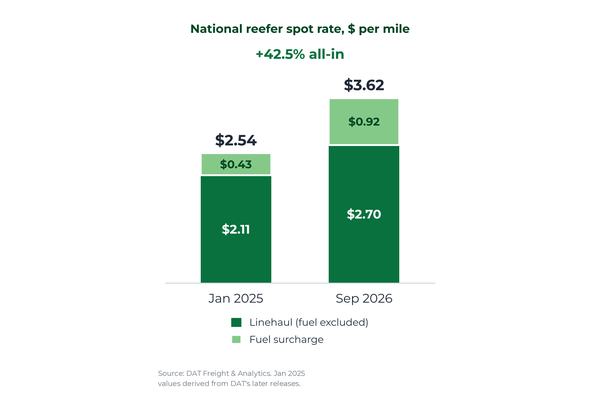
A refrigerated truck now earns $3.62 for every mile it rolls, a record and more than a dollar above where rates stood in January 2025. Strangely, there is less freight to haul. DAT Freight & Analytics reports that the national average reefer spot rate reached $3.62 per mile all-in in September 2026, up 42.5% from roughly $2.54 in January 2025, while its reefer volume index sits about a quarter below that starting point. Take fuel out and the linehaul rate still rose 28%, from about $2.11 to $2.70 per mile.
The gap between those two numbers tells the story. The fuel surcharge in the average reefer rate climbed from roughly 43 cents to a record 92 cents per mile, about 45% of the total increase. Contract rates followed, with DAT’s all-in contract reefer rate reaching a record $3.58 per mile in September, up from $2.75 in January 2025. Back then, spot traded about 21 cents below contract. Today it sits 4 cents above it, a sign that carriers can earn more on the open market than under many contract rates.
Rising rates on falling volume point to a supply problem, not a demand boom. In DAT’s data for the week ending October 31, the national reefer linehaul rate averaged $2.71 per mile, 31% above a year ago and about 27% above its nine-year average of $2.13. Reefer truck posts fell 4.3% while load posts rose 1.8%, pushing the reefer load-to-truck ratio to 15.7, up from 11.0 a year earlier. Contracted carriers are turning away freight, too: SONAR data reported by FreightWaves put reefer tender rejections at 21.4% on October 20, roughly 1 in 5 loads, and by November 4 they had moved past their Labor Day peak. A federal rule limiting non-domiciled CDLs, in effect since March 16, 2026 with most existing licenses grandfathered, could keep trimming the driver pool.
What this means for you: Budgets and bids built on 2025 reefer rates are likely to come up short. Shippers who plan capacity ahead of peak weeks, track how often their routing guides are actually honored, and benchmark contract rates against the current market are best positioned to manage the swings.
Diesel Above $6: Why Falling Crude Isn’t Helping
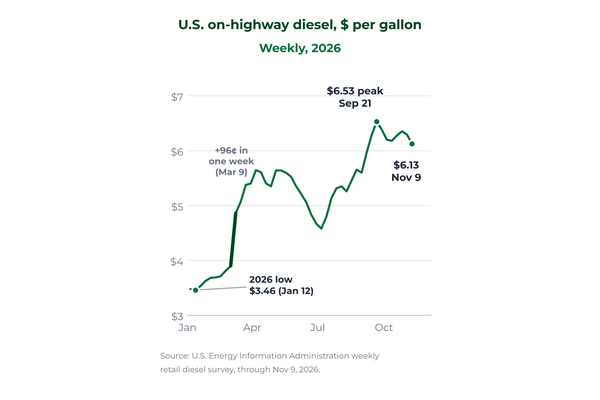
Since October 30, Brent crude has dropped 21%. Truck stop diesel has dropped just 2.5%. That is the puzzle facing every fleet, and every shipper, paying a fuel surcharge. EIA reports national on-highway diesel at $6.13 per gallon for the week of November 9, down 16 cents from the prior week but about 60% above a year ago ($3.84). It has now stayed above $6 for nine straight weeks.
FreightWaves explains it this way: diesel is expensive because refined product supply, not crude, is the bottleneck. The refining margin on a gallon of diesel was $2.51 on November 9, versus an average of 87 cents in January and February, roughly triple. The International Energy Agency puts Middle East refined product exports at 1.9 million barrels a day, against 4.7 million before the war, and the Strait of Hormuz closure and Red Sea blockade have stretched some tanker voyages from about 24 to 54 days. At home, U.S. refineries ran at 96% in the third quarter with no spare capacity, and distillate stocks were 13% below the five-year average in late September.
The Northeast has an extra reason to watch. EIA reports East Coast distillate stocks were 32% below the five year average in September and expects them to stay 20% to 30% below average through the winter, a thin cushion if cold weather arrives. EIA’s October outlook had retail diesel staying above $6 before easing gradually to about $4.50 on average in 2027. FreightWaves reports that EIA’s November update sees diesel near $6.05 in the fourth quarter and $4.80 by the fourth quarter of 2027, while warning that short term swings will exceed that smooth path.
What this means for you: Many fuel surcharge programs are indexed to the weekly national diesel price, so relief shows up in your invoices gradually, not overnight. Check how your carriers’ schedules are indexed, and build fuel into budgets as a moving target rather than a fixed line.
Thanksgiving Rush and Winter Outlook
The Thanksgiving bird is back in force, and it is moving through the cold chain right now. USDA projects about 198.5 million turkeys raised in 2026, up 3% and the first increase since 2023.
Thanksgiving falls on November 26, and DAT expects reefer loads to pull forward into the week before the holiday. Its 35 day forecast has national reefer linehaul near $2.73 per mile (range $2.64 to $2.82), roughly flat from today’s $2.71. Harvest freight is adding pressure in the Northwest: FreightWaves reported on November 4 that the Pacific Northwest is tight on Idaho and Oregon harvests, with Twin Falls, Idaho posting some of the largest reefer rate increases in the network, and IEL Freight notes that carriers there may find fewer attractive reload options. USDA lane rates for November 3, reported by DAT, were up 51% year over year in Washington, 39% in California and 16% on Texas border crossings, even as national produce volume was down 7% from last year.
Winter weather may offer some relief. AccuWeather’s 2026-27 outlook calls for a potentially record strength El Niño, which tends to mean a milder, less snowy winter across the Northeast, Midwest and Northwest. Philadelphia is forecast to get 5 to 15 inches of snow (30.1 last winter), and Boston 15 to 30 inches (62.8 last winter). Cold snaps are still possible, though, and AccuWeather flags a possible big East Coast storm in late January and February.
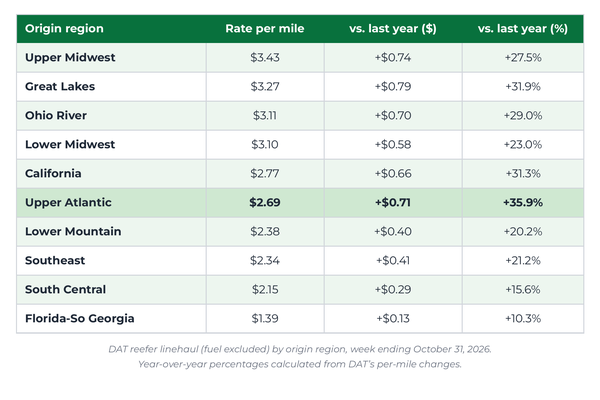
For freight leaving the Northeast and Mid-Atlantic, DAT’s Upper Atlantic origin region averaged $2.69 per mile for the week ending October 31, up about 36% from a year earlier. Here is how every top origin region compares:
As we head into the holiday season, the pattern across all three topics is the same: tight capacity, costly fuel and a calendar full of peaks reward the shippers who plan early. We will keep monitoring the data and sharing it here, and as always, RLS Logistics remains committed to delivering best-in-class cold storage, transportation, and fulfillment solutions and helping you thrive in any market conditions.
